You spoke, “we” heard you. Thanks to an incredible collaboration and winter season, Bonanza Flat grooming and Transit to Trails is back! Running weekends through May 21 dependent on weather and conditions.

You spoke, “we” heard you. Thanks to an incredible collaboration and winter season, Bonanza Flat grooming and Transit to Trails is back! Running weekends through May 21 dependent on weather and conditions.

The Salt Lake Climbers Alliance (SLCA) has worked this past year to preserve Utah’s climbing legacy by nominating the Alpenbock Loop Climbing Area in lower Little Cottonwood Canyon for the National Register of Historic Places (NRHP). This would be the first recreational climbing area to be listed in the nation! Once it’s listed, it will also be posted in the National Register database and in the Library of Congress, both digitally available.
For more information on this historic achievement visit: www.saltlakeclimbers.
AND THEN THERE WAS MUD. . .


Wow! The winter of ’22-’23 has been one for the record books, both in depth and duration. Park City Mountain stopped spinning their lifts on Monday of this week and our team completed its final groom in Round Valley just a day earlier. And now, thanks to unseasonably warm weather, we have transitioned from the biggest winter of our lifetimes to full-blown mud-season, seemingly overnight. While we would all like nothing more than to shift directly from white, to brown pow, it’s going to be a few. And don’t shoot the messenger but we’re looking at a rain/snow mix for the next several days.
We hate to get preachy, but every spring as the temps rise, and the dirt reappears, we find ourselves trying to educate trail users and discourage muddy trail use. So, please help us spread the word. It’s a fairly straightforward concept, really. ANY kind of soil displacement will lead to erosion and trail damage. Low spots and ruts created by foot, paw or tire are ALL culprits. That said, we strongly encourage ALL trail users (yes, that means you too, hikers, runners and dog walkers) to turn around if it’s sticking to heels, wheels or paws. And walking/running or riding around the muddy spots is never ok as it damages vegetation and widens the trail. Let’s keep our singletrack “single”.
This time of year, “variable” and “aspect-dependent” are the words of choice when describing lower elevation trail conditions. On any given trail you can, and will go from south-facing and bone-dry, to north-facing and snow-covered or “snud”, a snow/mud mix, on all points in-between. So, when you see a closure up at the trailhead and dry ground just on the other side of the closure, don’t assume that the rest of the trail, or the trail system as a whole, is also good to go.
The Mountain Trails crew has no lack of work ahead this spring/summer and we’d much rather focus our efforts on new trail projects, than repairing unnecessary, user-created, trail damage. That said, the onus of responsibility falls on YOU, the trail user to use good judgement out there. Let’s do our part to protect this amazing resource that we all love. Patience grasshoppers. Mud really is murder on our local trails.
It’s good to have options…
If you’re a long-time local, you already know that there is no better time than spring, to venture down to the desert for some red rock trail adventures in Moab, Fruita or St. George/Hurricane. Just down the road in the beautiful Heber Valley, the Dutch Hollow and lower Riverview/Coyote trail systems are great early-season options – once they dry out. Visit Wasatch Trails Foundation for updates. Looking for some great, low-impact, trail options locally? We have well over 30 miles of wide, natural-surface and paved pathways in the greater Park City area. And let’s not forget the 27-mile-long, Union Pacific Rail Trail- all of it in Summit County!
Trail Condition Info…
While it will never be a perfect system, we’ll continue to do our best to keep you in the know on changing conditions. As you may already know, we regularly post condition updates on our Facebook page, Instagram and website, but here are a few additional resources…
You can get a visual snapshot of current conditions by going to our website; https://mountaintrails.org clicking on the “Trails and Maps” dropdown, and then click “Interactive Map” followed by the “conditions” filter.

For the Snyderville Basin Area trails go to:https://www.
What’s the big deal about muddy trail use? Here are a few older, but still pertinent posts, that will shed some mud, and hopefully some light. The first is spot on for Park City…
http://parkcitymountainbike.
Happy Cinco de Mayo and happy Spring!
Rebecca Marriott Champion, long-time resident and local hiker, donated to MTF to meet the match requirement for Seldom Seen grant funding. In building Seldom Seen for downhill bike traffic, we create a hike-friendly zone including Silver Spur, Armstrong, Dawn’s and Lower Spiro trails. Many thanks to Rebecca for having a vision for this hike-friendly route and for putting a winning donation where her feet go!

The 2023 bike swap has been announced and its new beneficiaries, the Park City High School Mountain Bike Team, are eager to have you participate. It’s a great opportunity to sell an old bike or equipment or buy new gear.
Don’t forget that if you want to sell anything it must be dropped off prior to the swap. Here are the details form PCHSMTB :
WHEN: Saturday, April 29, 8am-5pm and Sunday, April 30, 11am-3pm
WHERE: Utah Film Studios: 4001 Kearns Blvd. Park City, Utah (across from Quinn’s junction)
Long before cell phones, Google Earth and apps like Trailforks and AllTrails, topographic paper maps were the tool of choice for navigating trail systems. Contour lines conveyed grade, elevation gain and loss, while serpentine, multi-colored, green, blue and black lines, represented new adventures of varying difficulty in the form of singletrack trails. In those days, it was understood that getting “lost” was a distinct possibility and sometimes welcomed.
Mountain Trails has been involved in the production of the Park City trail map since the original went to print in 1998. Thanks to Dawn Bowling, (our beloved resource manager, who we lost to cancer in 2013), for being a packrat of best kind, and hanging onto at least one copy of each map over the years. Now, carefully stored in a plastic tote labeled “Map Library”, they represent a physical, historical timeline of the growth and evolution of our trail system, from a handful of hand-built pirate trails, mine roads and mine grades, to the 500 mile, world-class, IMBA Gold Level trail system we have today.
The original, “1998 Hiking & Biking Trail Map”, as it was titled, is a small and simple, yet purposeful production. On the front you’ll find what looks to be a hand-drawn overview map showing a hodgepodge of mine roads and just a few dozen trails, including Park City hand-built classics like Gravedigger, Sweeny’s Switchbacks, the original Tour Des Suds (pre-Empire Pass), TG1 & 2, along with a lone Round Valley trail labeled; “Round Valley”. You’ll also discover some long-forgotten gems like Jurassic, Bed Springs and my favorite, a trail named “Game Trail”. On the back side are several color-coded elevation profiles and descriptions of various routes throughout the area. This was a true adventure map, with no trail mileage or difficulty ratings and no topos to discern grade or elevation gain and loss. Your only reference points were one of the many artist renderings- historical and non-historical landmarks including various mine buildings, the ”Old Car” in Round Valley, the “Water Tank” in Daly Canyon, along with the “Blue Dumpster” and “Junk Yard”.
Two years later, at the turn of the century, our trail system was beginning to blossom. The 2000 trail map mirrors this expansion, with miles of “purpose-built” trails like the newly completed- Spiro at Park City Mountain Resort, Lost Prospector high above the Rail Trail and Deer Valley Drive, and Rambler, Kari’s & High Side in Round Valley. Also represented was an extensive lift-served system at Deer Valley with 45+ miles of trail along with sections of the Mid Mountain Trail, some complete and others still labeled “under construction”.
Mountain Land Association of Governments or MAG, GIS coordinator, Andrew Woolly would produce those first few early cartographic efforts, before Trish Murphy Cone, also with MAG, would take the reins in 2003, beginning a 16-year run as designer/cartographer. There would be literally hundreds of miles of trail and thousands of acres of protected Open Space added to the map during that time. Trish did a phenomenal job documenting that growth and understood the need for a detailed and accurate map. Her passion for trails, wildlife, the open spaces that supported them and local history were obvious and always on display. Her attention to detail and personal touches contributed in a big way to the map’s character and long-running success.
I would literally have to write a novel to describe all the changes/additions that took place with the map over the next two decades, but here are a few of the major highlights to give you a sense of what was taking place:
2005- includes the iconic Mid Mountain Trail in its entirety, a well-developed system in the Glenwild area, north of I-80, that included the Stealth trail, Cobblestone, 24-7 along with some early downhill, bike-only trails in the new, Bob’s Basin. Rob’s, Collin’s & Ambush are complete, the Swaner Nature Preserve is highlighted, and several sponsored trail loops are identified, including the Glenwild Loop, Lost Prospector loop, the High Alpine Loop and the Town loop.
2007- Flying Dog is complete at Glenwild along with new trail offerings at the Utah Olympic Park, including ???? conservation efforts were well under way and protected easements that enabled trail development would be highlighted and shown in the legend as “Protected Open Space”.
2009- the Old Town window of the map would be flipped to a “bottom up”, users’ perspective, in an effort to better represent the nearly 3,000 feet of vertical relief from Main Street to the Wasatch Crest.
2011- the now vast system would be broken down into six distinct, color-coded, trail area “windows”. The map would also mirror wayfinding signage on the ground with newly added “Location Markers” in Round Valley, Glenwild, the Mid Mountain Trail and the Wasatch Crest.
2012/13- Park City’s recent designation as “The World’s First IMBA Gold Level Ride Center” would be acknowledged on the cover along with new trail additions, Armstrong, Jenni’s and Pinecone Ridge
2014- future ED, Lora Smith, would grace the cover, and the first “MTF Crew” photo would be added under the legend, the start of a new tradition
2017- MTF 25th anniversary map with many historical trail photos and acknowledgment of individuals who played a role in creating the PC trail system. Freemason is new.
2020- Bonanza Flat first appears on the map and includes the Blood’s Lake trail
2021- with the continued expansion of our trail system into areas like Clark Ranch, Skyridge and Bonanza Flat, we transition into a 2-map, format. Charlie’s 9K is complete along with the Lake Lackawaxen trail.
2022- weather and tear-resistant paper is used for the first time, improving the durability of the map
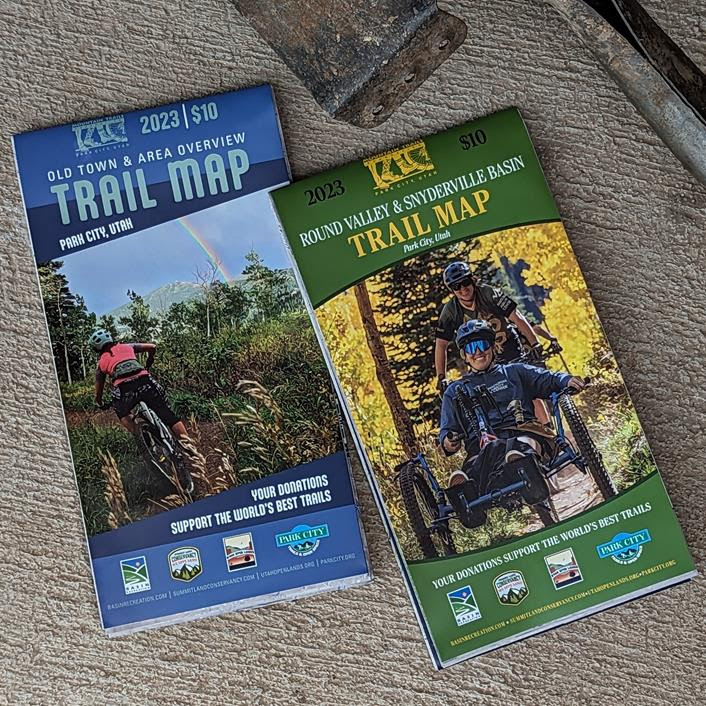
The map covers have always been an integral piece of the MTF map production. They represent different trails users, uses and experiences as well as our local trail culture. And what better way to show off our trails! Over the years the covers would also acknowledge and memorialize individuals who played a major role in the trajectory of our organization and trails in general, including previous Executive Directors, Carol Potter and Charlie Sturgis and Basin Rec trails planner, Senta Beyers. One year, we even did a cover of our trail crew on the Pulp Friction work site. More recently, in an effort to maintain that organic, home-grown feel for the map, we have held a yearly cover-photo contest. The map “panels” would be used to promote our long-running summer trail running series, trail etiquette and to recognize a quickly growing list of Adopt-A-Trail sponsors. We have packed a lot into those 27×36” pieces of paper.
In 2019, Trish would retire from the “little” map production she helped create, and in 2020, with big shoes to fill, we would welcome cartographer, Jay Hill, to the team. Jay brought with him 14 years of GIS experience working for the Utah Geological Survey branch of the DNR. With a fresh set of eyes and a passion for mapping and mountain biking, Jay would tap into the latest technology to visually enhance the map, along with a renewed focus on emphasizing the trails, themselves.
For 2023, we’ll have new trail additions including Mother Urban, Cyn City, Sparky, Change Reaction and Ripple at Deer Valley. The accuracy of our trail files will be improved, and the background and trail colors will be enhanced to improve the overall look of the map.
While the demand for paper maps may not be what it once was, they remain a viable tool for those of us who prefer a physical, hands-on, reference. You’ll still find the MTF map in bike shops, at the Chamber, on garage and office walls, and in backpacks. Like our trail system, the map has always been a work in progress. Looking through these maps in detail over the past week has been an eye-opening reminder of how much effort has gone into their creation, and that of our trail system. As the saying goes, “It takes a village”, and there have been many villagers involved in this ongoing legacy. We owe them all a great debt of gratitude.
MountainTrails.org
About Us
Careers
P.O. Box 754
Park City, UT 84060